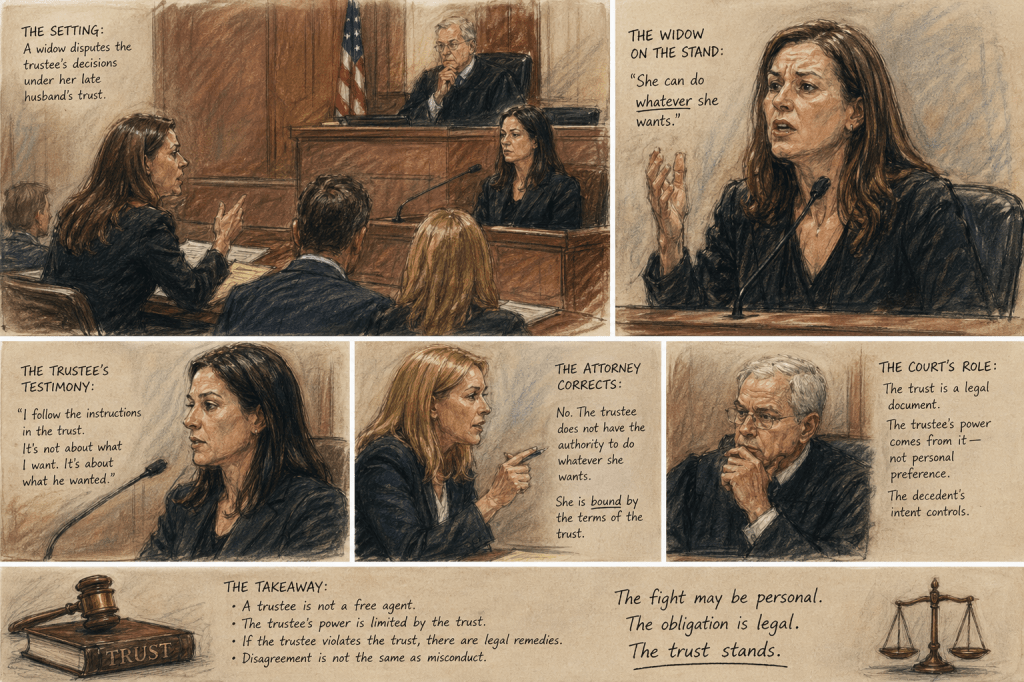
A widow sits in the home she shared with her husband, now gone.
She assumes what many surviving spouses assume: that everything naturally passes to her. The house. The accounts. The control. The authority to decide what happens next.
But then reality sets in.
The trustee, has informed the widow: She is allowed to live in the home, but she cannot sell it. She cannot access certain assets. She has no authority over the property her husband brought into the marriage. Decisions she thought would be hers to make are now out of her hands.
And the person holding that authority? Her sister-in-law.
What follows is predictable. Frustration turns into anger. Anger turns into conflict. And eventually, the dispute escalates beyond family tension into something far more serious.
By the time the issue reaches a courtroom, the narrative has hardened: the trustee is controlling, unfair, and abusing her power. The widow testifies that the trustee can “do whatever she wants.”
That statement feels true emotionally.
It is legally wrong.
What a Revocable Trust Actually Does
A revocable trust is not just a probate-avoidance tool; it’s a control mechanism.
During life, the person who creates the trust (the grantor) typically serves as trustee and maintains full authority over their assets. They can amend the trust, revoke it, or manage the property however they choose.
At death, everything changes.
The trust becomes irrevocable. The grantor is no longer there to make decisions. Instead, the instructions they left behind become binding, and a successor trustee steps in to carry them out.
That trustee does not inherit power in a personal sense. They inherit responsibility.
The Trustee’s Power Is Not Personal
A trustee’s authority comes from one place: the trust document.
Not from family dynamics. Not from personal judgment. Not from what feels fair.
If the trust says:
- The surviving spouse may live in the home but cannot sell it
- Certain assets are to be preserved or distributed in a specific way
- Premarital property is to be handled differently
Then the trustee must follow those instructions exactly.
Even when it causes conflict.
Even when it feels inequitable.
Even when the trustee personally disagrees.
This is the core misunderstanding in many trust disputes: beneficiaries often view the trustee as the decision-maker, when in reality, the trustee is the administrator of a decision already made by the decedent.
“She Can Do Whatever She Wants” … No, She Can’t
The idea that a trustee can “do whatever they want” is a common, but incorrect assumption.
Trustees are fiduciaries. That means they are legally bound to:
- Follow the terms of the trust
- Act in the best interests of the beneficiaries as a whole
- Avoid self-dealing or conflicts of interest
- Administer the trust prudently and in good faith
They cannot:
- Rewrite the trust
- Ignore restrictions
- Favor one beneficiary unless the trust allows it
- Withhold distributions arbitrarily
If they do, there are consequences.
When a Trustee Gets It Wrong
If a trustee violates the terms of the trust or breaches their fiduciary duty, beneficiaries have legal remedies.
Those remedies include:
- Petitioning the court for an accounting
- Seeking removal of the trustee
- Bringing a claim for breach of fiduciary duty
- Requesting court instructions or supervision
The system provides structured, enforceable ways to challenge misconduct.
What it does not provide is the ability to override the trust simply because the outcome is disappointing.
The Real Source of the Conflict
In situations like this, the conflict is rarely just about the trustee.
It is about expectation versus reality.
The surviving spouse expected ownership. The trust granted occupancy.
The surviving spouse expected control. The trust imposed limits.
And when those expectations collide with the written terms, the trustee becomes the face of a decision they did not make.
Final Takeaway
A revocable trust allows a person to control what happens to their assets after death, sometimes in ways that surprise the people left behind.
The trustee’s role is not to soften those decisions. It is to carry them out.
That may feel harsh. It may feel unfair.
But from a legal standpoint, it is neither.
It is the enforcement of intent.
 Sadity Esq
Leave a comment